
Forestry Mulching in Shallotte, NC
Forestry mulching grinds brush and small trees into a mulch layer where they stand, with one tracked machine and nothing left to burn or haul. Around Shallotte that last part matters: burning land-clearing debris in Brunswick County generally means an NC Forest Service permit, 500 feet between the fire and the neighbors' homes, and a day without an air-quality alert. Here's how mulching works, where it fits the sandy, wet, fast-building ground of southern Brunswick County, where it doesn't, what it costs, and which town and county rules can still apply.
How it works
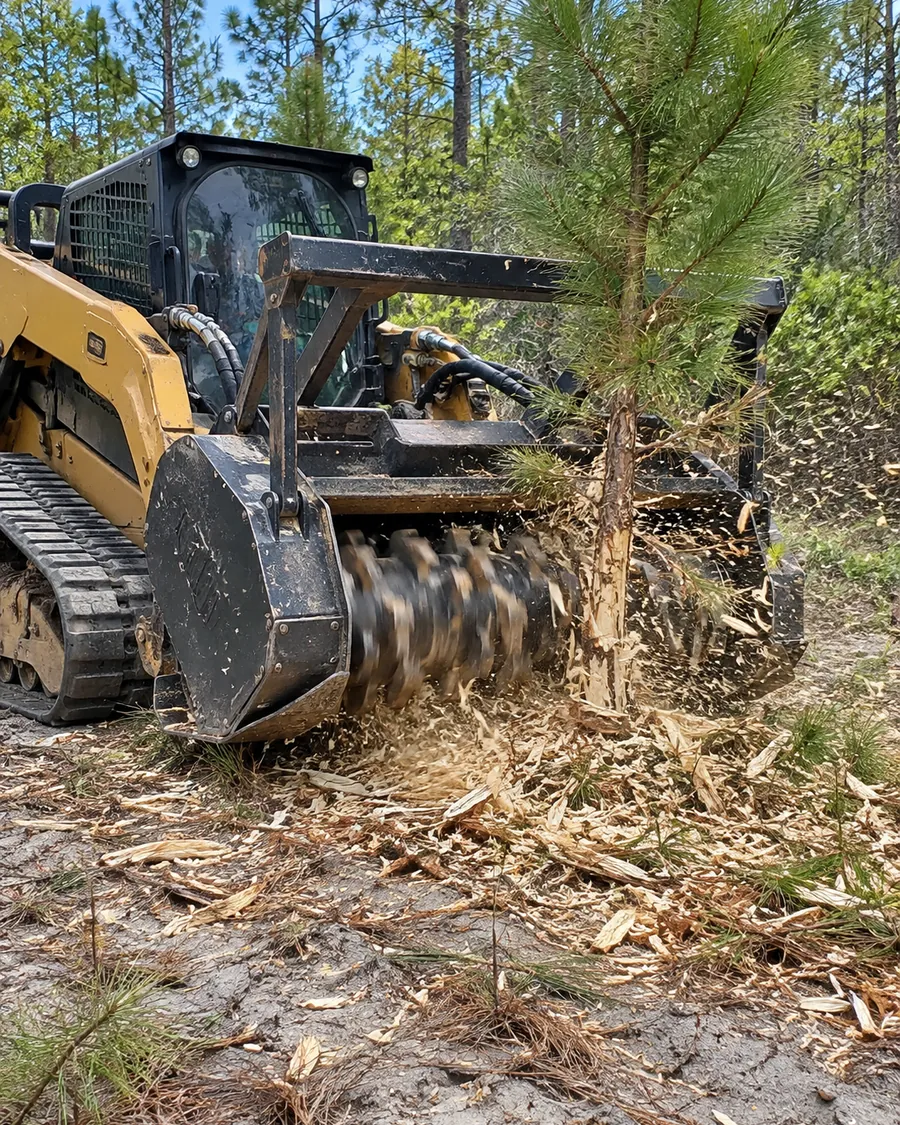
The working end of a forestry mulcher is a heavy spinning drum set with steel or carbide teeth. It rides on a compact track loader, a skid steer, an excavator arm, or a tracked carrier built for the purpose. As the operator pushes into standing brush and trees, the head chews them down from the top, and the chips land where they fall as a layer of mulch. Nobody cuts ahead of the machine, nothing gets piled to burn, and no trucks haul brush away. It's one operator on one machine, making one pass.
On compact machines, most heads are made for brush and stems up to roughly 6 to 8 inches across; operators around the region commonly quote about 8 inches. Larger heads on high-flow or dedicated carriers can handle more, and they bill a higher hourly rate for it. Anything bigger is either sawed down and mulched piece by piece, or the job turns into conventional clearing. Ask each contractor how thick a trunk their machine handles comfortably.
Why it suits southern Brunswick County
Brunswick County's development ordinance describes a county with "numerous waterways, marshes, Carolina Bays, pocosins, and other water courses." It's also growing faster than any other county in North Carolina: Census estimates put its growth at 27.8 percent from 2020 to 2025. On low ground with neighbors moving in on every side, the reasons to clear lightly add up:
- Nothing to burn. Brunswick is one of the state's high-hazard fire counties, so outside town limits an NC Forest Service permit is required for an open burn more than 100 feet from an occupied dwelling, at any hour. The state air rule adds a 500-foot setback from neighbors' homes for land-clearing fires. On a lot in a filling subdivision, that setback can be impossible to meet. Mulching skips all of it. More on burn rules.
- Roots stay in. Because nothing gets pulled up, low ground isn't left pocked with stump holes that fill with water, and the sandy soil keeps its structure.
- The keepers stay. An operator can work around live oaks, longleaf pines, and dogwoods without cutting their roots. That matters here: the county's ordinance counts those species as heritage trees at just 4 inches across, and Shallotte's adds redbud at 4 inches and American holly at 8.
- It isn't a clear-cut. The county's ordinance says properties "shall not be clear-cut prior to undertaking development activities." Thinning the understory and keeping the canopy is a different thing.
Typical mulching jobs around Shallotte
- Clearing the understory on a wooded lot so you can see and walk it before deciding where the house goes.
- Clearing most of a homesite before the builder's footprint is grubbed.
- Property lines and fence lines that have grown shut. Have the corners found first.
- Trails, lanes, and shooting lanes on larger tracts.
- Firebreaks along the woods behind a house.
- Knocking back invasive plants. The NC Forest Service lists Chinese tallowtree, mimosa, Callery pear, kudzu, Chinese and Japanese wisteria, and Japanese honeysuckle among the invasives that are "particularly good at invading disturbed sites."
When it's the wrong tool
- Under anything you'll build. Buried roots rot, and the ground above them settles. Under a house pad, slab, driveway base, or septic drainfield, the stumps and roots have to be grubbed out. Mulch the open acreage and grub just the footprint.
- On the septic area. North Carolina's septic rules say soil disturbance or compaction "shall not occur over the initial and repair dispersal field area." Once the county has laid out your drainfield and repair area, keep machines off them, mulcher included.
- Big timber. Mature pine and hardwood are beyond most mulchers, and on a real stand may be worth selling first.
- Near the marsh without asking. Within 75 feet of the marsh or estuarine shoreline you're in a CAMA Area of Environmental Concern, where clearing that's part of building needs a permit. See marsh-side and waterfront lots.
- Saturated ground. A wet pocosin or Carolina bay bogs down even a tracked machine, so plan on waiting for a dry spell.
- When you need bare soil right away. Under a deep mulch layer, seed can't reach the soil until the mulch has been raked off or has broken down.
Regrowth
A mulcher cuts the hardwoods down, but it doesn't kill them. According to the U.S. Forest Service's species guides, sweetgum comes back from root sprouts, and red maple sends up sprouts within two to six weeks of being cut. Pines are different: a cut pine stump won't resprout, although new seedlings will blow in. Expect to mow down the sprouts during the first year or two, follow up with herbicide on the worst species, or do both. In North Carolina, anyone applying pesticides for pay on someone else's property needs a state pesticide license, so if a contractor offers to treat stumps or spray regrowth, ask whether they hold one.
What forestry mulching costs
The nearest published mulching price comes from Mint Condition Land Management, which serves the Hampstead and Surf City area and lists forestry mulching "Starting at $1,600/acre." The national cost sites give ranges. Angi's May 2026 numbers are $1,000 to $2,500 an acre, at $150 to $300 an hour. HomeAdvisor's, from June 2026, are $125 to $400 an hour, or $400 to $1,500 an acre, depending on density. Contractors may price the work by the acre, the day, or the machine hour. Around Shallotte, the price moves with how big and how thick the stems are, wet ground and rain days, the distance the machine has to travel, the minimum charge on a small lot, and how much care it takes to work around the trees you're keeping. None of these figures is a quote for your land. More on cost.
Does mulching need a permit?
It can. Three things to check:
- State erosion law. A written erosion and sedimentation control plan is required before disturbing more than one acre, and DEQ says erosion control is required "regardless of the size of the disturbance." The law defines land-disturbing activity around development that changes "the natural cover or topography." No official guidance says how mulching that leaves roots in place is treated, so on a job over an acre, ask DEQ's Wilmington Regional Office (910-796-7215) before you start.
- Town rules. Shallotte's ordinance requires a certificate of zoning compliance for land clearing before development. Carolina Shores requires a permit for all tree removal, Sunset Beach requires a Tree Clearing Certificate before undeveloped land is cleared, and Calabash lists lot clearing and tree removal among the work that needs a permit.
- Water. Near the marsh or a creek, CAMA and stormwater rules can apply at any size.
The permits guide has the details and phone numbers.
Forestry mulching questions
Will the mulch hurt my yard or field?
Not if it's thin. A light layer breaks down into the soil, and grass grows up through it. A deep layer is another story: it ties up nitrogen while it decomposes, and new seed struggles until the mulch is raked off or has had a season to break down. To learn how much lime and fertilizer the ground needs, get a soil test.
Can the operator work around trees I want to keep?
Yes. Mark every tree you're keeping and settle on how close the machine may come. With live oaks or longleaf pines on the lot, get that done before anyone shows up.
How long does an acre take?
It depends on density far more than size. Thin brush can go in a few hours; a thick stand of sweetgum and pine takes much longer, and wet ground slows everything. Ask for an estimate in machine hours.
Should I cut the trees down first?
Usually not. A mulcher does its best work on growth that's still standing, and trunks lying every which way slow it down. Check with the contractor before you start cutting anything.
How we help
Tell us where the land is, about how much of it there is, and what's growing on it, by phone or with a short request. One independent contractor who works in southern Brunswick County gets it, walks the property, and quotes the job. You decide from there, and the referral is free.
Want a local contractor to walk your land?
Call or send a short request. There's no charge for the referral.